Why You Can Spend $500 on Google Ads and Still Get 0 Conversions
Short summary:
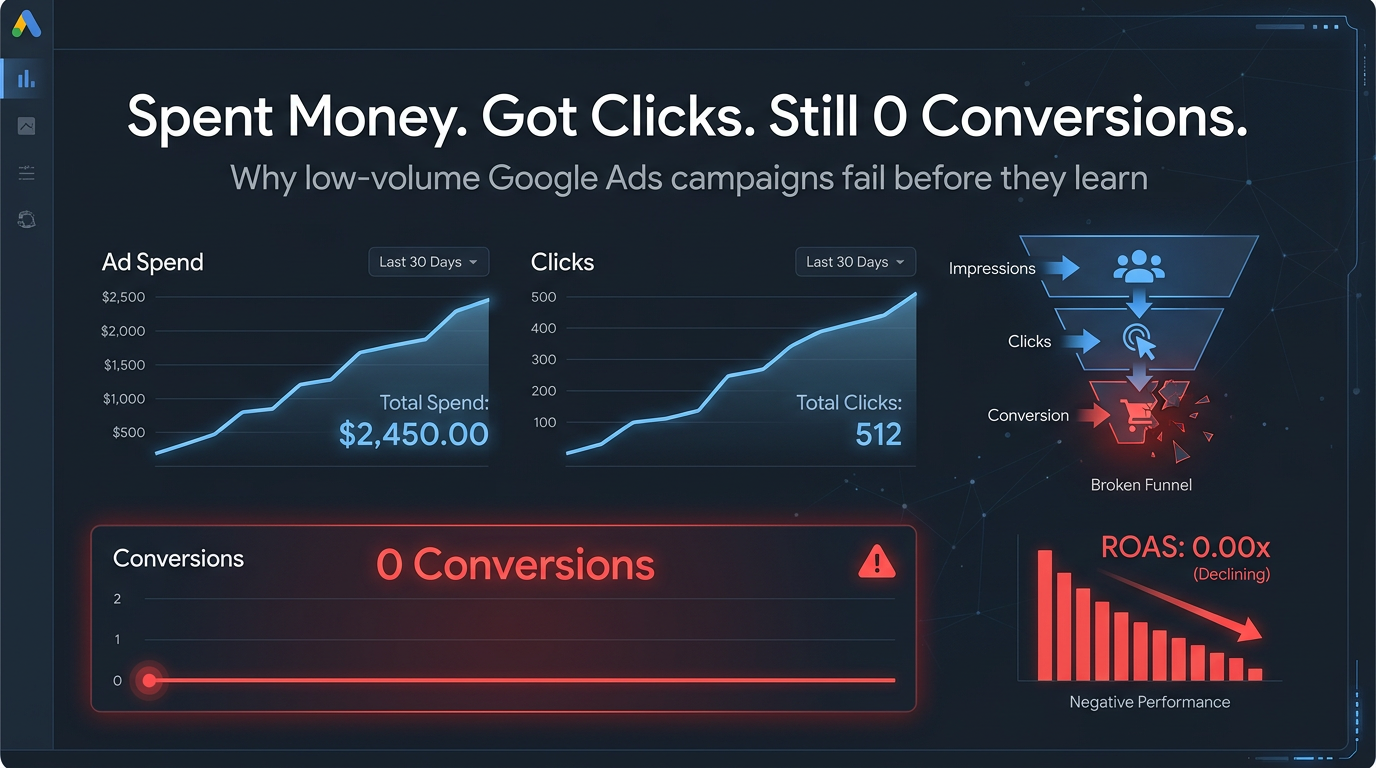
Spending money on Google Ads and getting clicks without conversions is one of the most frustrating moments in paid acquisition. But in low-volume campaigns, the first diagnosis should not be panic. It should be structure. Before declaring the channel broken, you need to audit tracking, search intent, landing page clarity, CTA friction, and trust signals. In other words: diagnose behavior before optimizing outcomes.
The Problem
A founder or agency owner launches a first Google Ads campaign.
After two weeks, the numbers look like this:
- Spend: $500
- Clicks: 160
- Conversions: 0
At first glance, this feels catastrophic.
And emotionally, it is easy to jump to one of these conclusions:
- Google Ads does not work
- The product is not attractive
- The landing page is broken
- The niche is too competitive
- More budget is needed
Sometimes one of those is true.
But not always.
What makes early paid acquisition difficult is that low-volume campaigns create a strange zone: there is enough data to feel worried, but often not enough outcome data to optimize confidently using platform automation alone.
That is exactly where behavioral diagnosis becomes useful.
What 0 Conversions Does — and Does Not — Mean
Zero conversions after 160 clicks does not automatically prove that the channel is broken.
But it does prove that something needs to be inspected immediately.
A useful framing is this:
160 clicks and 0 conversions is not enough to kill the channel.
It is enough to trigger a serious audit.
That distinction matters.
Because the wrong move at this stage is usually one of these:
- keep spending blindly
- change everything at once
- trust automated bidding too early
- conclude that the offer is bad without checking intent quality
- conclude that the ads are bad when the landing page is the real bottleneck
A Quick Numerical Reality Check
With $500 spent and 160 clicks, the average cost per click is:
CPC = 500 / 160 = 3.125
So the campaign is buying traffic at about $3.13 per click.
That number alone is not alarming. In many competitive B2B, agency, software, and marketing-related categories, that can be completely normal.
The alarming part is not the CPC.
The alarming part is that the funnel has produced no measurable outcome yet.
If tracking is correct, then the working assumption should be:
The campaign is not yet producing enough trust, enough relevance, or enough clarity to move people into action.
Why Low-Volume Accounts Are Hard
Google Ads works best when the system has enough clean conversion data to learn from.
That creates a structural problem for new accounts and low-volume campaigns:
- you need conversions to optimize
- but you need optimization to get conversions efficiently
This is the cold start problem in paid acquisition.
In practice, this means:
- automated bidding may learn slowly
- broad targeting can become expensive
- weak landing pages get exposed quickly
- low-intent traffic is hard to separate from high-intent traffic if you only look at final conversions
That is why early-stage paid acquisition should not rely only on final conversion counts.
It should also look at behavioral evidence.
The 5 Most Likely Failure Points
When a campaign has clicks but no conversions, I usually audit these five areas first.
1. Broken or Incomplete Tracking
This is the first thing to verify because everything else depends on it.
A campaign can appear to have zero conversions even when users are actually:
- submitting forms
- clicking calendar booking links
- starting checkouts
- completing lead actions that are not tracked correctly
Questions to ask:
- Is the conversion event firing at all?
- Is the thank-you page loading properly?
- Is the form submission tied to a real event?
- Is GA4 receiving the event?
- Is Google Ads importing the correct conversion action?
- Is there a mismatch between GA4 and Google Ads conversion definitions?
If tracking is broken, then the problem is measurement before performance.
2. Wrong Search Intent
Many campaigns attract traffic that is relevant-looking but not truly high-intent.
That distinction destroys budgets.
For example, a campaign might match users who are:
- researching
- comparing options casually
- looking for free tools
- searching for jobs
- learning terminology
- browsing without urgency
The keywords may seem related to the offer, but the user’s actual intent may be weak.
This is why search term reports matter so much in the first phase.
Not just keywords.
Actual search terms.
If the traffic intent is wrong, no amount of small landing page optimization will fix the core problem.
3. Weak Landing Page Clarity
A visitor should understand the answer to these questions in seconds:
- What is this?
- Who is it for?
- What outcome do I get?
- Why should I trust it?
- What should I do next?
If the page is vague, clever, generic, or over-written, paid traffic struggles.
This is especially common in categories like agencies, SaaS, and consulting, where pages say things like:
- grow faster
- scale better
- unlock performance
- transform your business
Those phrases sound polished, but they do not reduce uncertainty.
And uncertainty kills conversion.
4. CTA Friction
A lot of landing pages ask for too much commitment too early.
For cold traffic, these CTAs often feel expensive:
- Book a strategy call
- Request a demo
- Fill out a long form
- Schedule a consultation
- Start onboarding immediately
The issue is not always that the CTA is wrong.
The issue is that the page has not yet earned the level of trust required for that CTA.
If the ask is high-trust, the page must first deliver high-confidence signals.
5. Trust Deficit
In many paid funnels, trust is the real conversion bottleneck.
This is especially true when the offer is intangible:
- marketing services
- consulting
- CRM solutions
- software
- lead generation
- optimization services
Users ask themselves:
- Has this worked for anyone like me?
- Is this credible?
- Is this established?
- Is this risky?
- Am I about to waste time?
Trust usually comes from some combination of:
- testimonials
- clear client outcomes
- case studies
- screenshots
- process transparency
- specific niche focus
- recognizable proof
Without trust, clicks are just visits.
Why “Just Wait for More Data” Can Be Expensive
A common response to underperforming campaigns is:
Give it more time.
Sometimes that is reasonable.
But sometimes “more time” is just a polite way of saying “keep paying for unclear traffic while learning nothing.”
Low-volume campaigns are especially vulnerable to this mistake because the account does not produce enough conversions for easy optimization, yet it still spends enough money to become painful.
The risk is not only wasted spend.
The bigger risk is delayed diagnosis.
If the real problem is:
- wrong intent
- broken tracking
- weak page clarity
- bad CTA fit
- trust deficit
then simply waiting will not solve it.
It will only purchase more evidence of the same problem.
What to Track Before the First Conversion Happens
This is where behavioral analytics becomes useful.
When final conversions are rare, I prefer to monitor micro-conversions and high-intent behaviors.
These do not replace the final outcome.
But they help diagnose the funnel earlier.
Useful signals often include:
- CTA click
- form start
- form field interaction
- calendar click
- pricing section view
- FAQ expansion
- scroll depth milestones
- time on page thresholds
- return visit within a short window
- visit to trust-heavy sections like testimonials or case studies
These signals help answer an important question:
Are users uninterested, unconvinced, confused, or blocked?
That is a much better question than simply asking why conversions are zero.
A Behavioral Diagnosis Framework
Here is a practical way to think about the problem.
| Symptom | Likely issue | What to inspect first |
|---|---|---|
| Many clicks, very short sessions | low intent or poor ad-message match | search terms, match types, ad copy alignment |
| Reasonable time on page, no CTA interaction | unclear value proposition | headline, subheadline, page structure |
| CTA clicks but no form completion | friction | form length, mobile usability, UX issues |
| Users visit pricing / testimonials but do not convert | trust deficit | proof, credibility, risk reversal |
| No conversions and no micro-conversions | severe mismatch | tracking, offer, intent, page clarity |
This framework is useful because it avoids a common mistake: treating every failure as an ad problem.
Sometimes the ads are doing their job.
They are bringing people to the page.
The page is where the failure happens.
How I Would Audit a Campaign Like This
If I saw a campaign with $500 spent, 160 clicks, and 0 conversions, I would check things in this order:
Step 1: Confirm Measurement
- verify form submit tracking
- verify GA4 events
- verify Google Ads conversion setup
- verify thank-you flow
- test on both desktop and mobile
Step 2: Inspect Search Terms
- look for low-intent queries
- add negative keywords aggressively
- tighten match types if traffic is too broad
- compare keyword promise vs landing page promise
Step 3: Evaluate Message Clarity
Ask a simple question:
Can a first-time visitor explain the offer after five seconds?
If not, the page needs simplification.
Step 4: Evaluate CTA Risk
- Is the ask too large for cold traffic?
- Is there a smaller step available?
- Can the user show interest without full commitment?
Step 5: Review Trust Signals
- proof
- specificity
- niche focus
- examples
- outcomes
- credibility markers
A Better Mindset for Early Campaigns
One of the biggest mistakes in early paid acquisition is treating conversion as the only signal that matters.
Conversion matters most.
But when the funnel is young, it is often the slowest signal.
In the beginning, you need a layered view:
- Traffic quality
- Engagement quality
- Intent signals
- Friction points
- Final conversion
If you only look at the last layer, you miss where the funnel actually breaks.
Final Takeaway
When a Google Ads campaign spends money, gets clicks, and produces no conversions, the correct response is not immediate panic and not blind patience.
It is diagnosis.
A useful rule is this:
If you do not yet have enough conversions to optimize outcomes, optimize understanding.
That means checking:
- whether tracking works
- whether the traffic intent is right
- whether the page explains the offer clearly
- whether the CTA is asking for too much
- whether the funnel has enough trust to support action
In low-volume campaigns, the first win is not always a conversion.
Sometimes the first win is identifying why conversion is not happening.
And once that becomes clear, optimization becomes much cheaper.
If You Are Working on This Problem
If you are running paid acquisition with low traffic, limited conversions, or early-stage GA4 data, this is exactly the class of problem I am interested in:
- behavioral diagnostics
- cold-start analytics
- micro-conversion design
- conversion modeling before the data is “large enough”
You can explore more writing on these topics on my blog, or connect with me on LinkedIn.